

Event Apps Aren’t Dead. But your WhatsApp group should be.
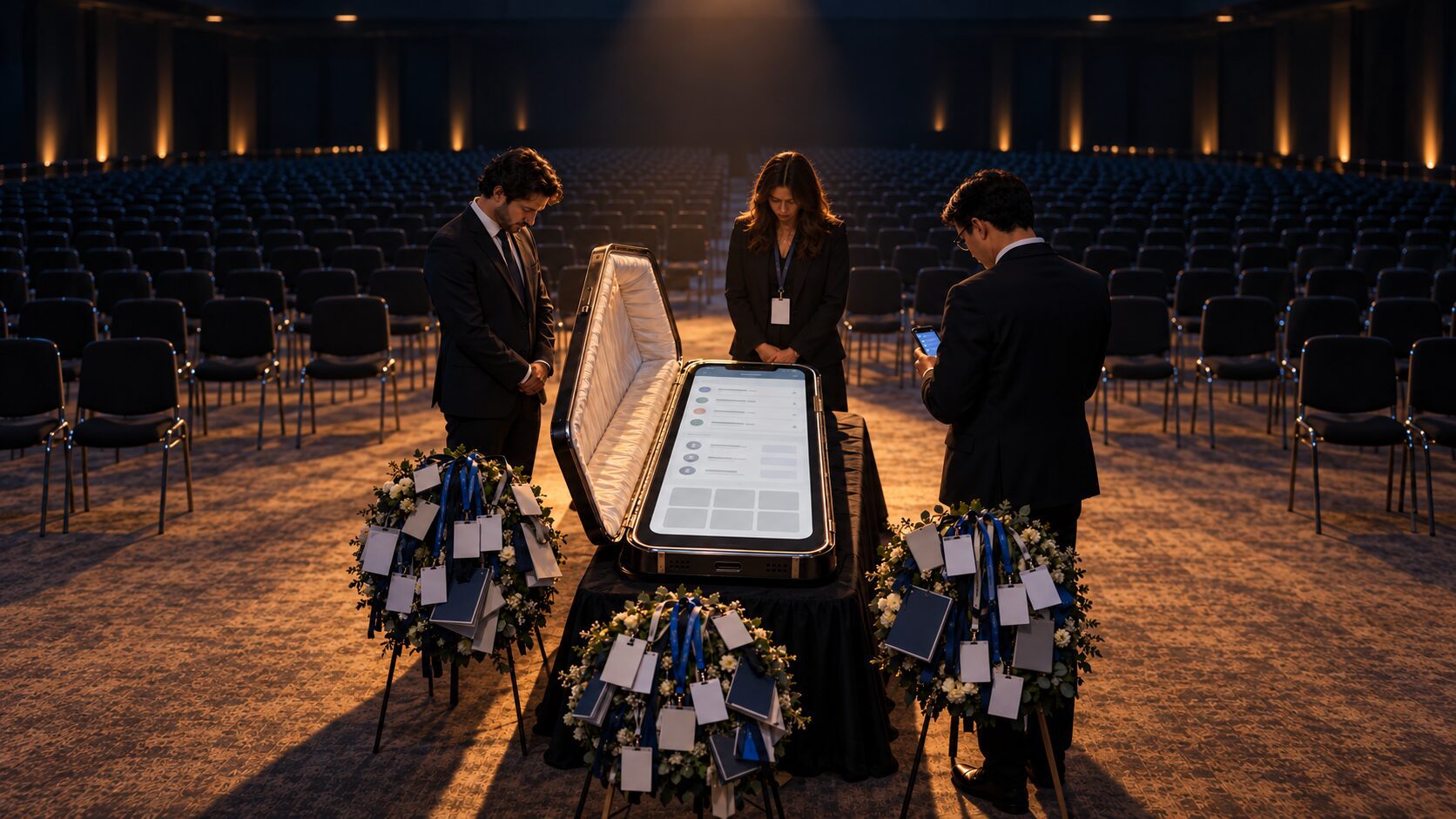
Every year, someone holds a funeral for the event app…
But here we are 10 years later still delivering them.
Event apps are not dead. But I agree that some of them should be, and I’ll happily help carry the coffin.
This week I watched a LinkedIn thread started by Gautam Singh do the rounds. His post opened with the usual:
- Networking is poor,
- WhatsApp works fine,
- Nobody downloads an app for a 36-hour event,
- Most apps are a PDF with a login,
The comments were even better. Julius Solaris said it’s stupid to run an event over 1,000 people without an app, while admitting apps have badly underdelivered on networking. Others pushed back, pitched alternatives, and my best an the most accurate response was;
Nothing says “we don’t need an app” like 400 unread WhatsApp messages by 11am on day one.
I’ve been in event technology for over 20 years, and we’ve been an authorised EventMobi partner across Africa, Australia and New Zealand for a long time. So I have skin in this game.
What the critics get right
- Some app companies deliver apps that were basically a programme booklet on a phone – basically an agenda, speakers, sponsors, map. Done. The client ticked a box, the delegates opened it twice, and everyone moved on.
- Networking has underdelivered. Matchmaking looks great in a demo. In the room, most people still meet over coffee, not through an algorithm. Exhibitors rarely see hard outcomes from it – if you want to get the most out of networking you need humans involved, I have a friend and industry colleague Tracy Harely, there is no better expert in delivering business matchmaking, if this is a requirement should definitely reach out to her. We have a whole strategy around it, happy to share it, just drop me a message,
- Too many apps are a checkbox. I totally agree, the apps that earned the bad reputation were usually bought last minute before the event. When the app is an afterthought, it behaves like one.
- Finding things is still too hard. Scrolling through 300 names or 80 sessions is not a feature. It’s homework. That’s when personalisation is important.
also, if your app is a digital PDF, it deserves to die. But that’s not a verdict on event apps. It’s a verdict on how they were planned.
What event planners get wrong
Nobody declares restaurants dead after one bad meal. Event Apps are not dead, but average apps should be.
Here’s what the “just use WhatsApp” crowd misses.
A WhatsApp group works beautifully for 20 people.
Somewhere around 50, it going to wobble.
By 300, it’s a firehose: the room change from 08:15 is buried under 140 thumbs-up emojis and someone asking where lunch is.
And then there is the privacy issue – who has whose cell number, and what POPIA and GDPR says about that.
The real job of an event app is not to hold content.
The Event App’s job is to be the one live version of the truth.
Change the room once, and it’s right everywhere: on the agenda, in the notification, at the help desk. That’s the bit no conference program, website PDF or chat group can do.
What I’ve seen work
Here are a few patterns that keep proving the “dead” app very much alive.
The app that starts before the event. For a large marketing industry conference this year, the app went live three weeks before the day, with over 2,000 registrants. We built a branded challenge journey with 41 challenges dripped across four weeks, layered quizzes where one right answer reveals the next clue, sponsor booth codes across 17 sponsors, and “listen-live” codes so online delegates could play on equal terms with the room. Nobody called it “the app”. They called it “the game”, and they arrived on the day already warmed up.
The app as an orientation companion and the event planner that sits in your pocket. Picture 500 first-time visitors to South Africa for a conference, many of them fearful because they been watching CNN and think they are going to be robbed the moment they land. This is where live announcements, personal agendas and maps earn their keep.
The app that carries a purpose, not just a programme. For a leadership conference, the brief wasn’t “put the agenda on a phone”. It was: help 350 executives reflect, commit to behaviours, and carry the conversation back to their teams. The app becomes the thread that runs before, during and after the event.
Right-sizing for the small event. Here’s the honest one. For a 120-person workshop, a full enterprise platform can be overkill, and the cost should be hard to justify. That’s where we offer a lighter option.
None of these are really about “an app”. They’re about solving a specific problem for a specific audience.
Change the ingredients of the cake
If you brief an app the same way you brief a printed programme, you’ll get a printed programme on a phone. So let’s identify the principles here.
- Start with the attendee’s question, not the organiser’s content. “I have 40 minutes and I’m near the exhibition hall. What’s worth my time?” is a better design brief than “we need a sponsor page”.
- One source of truth. Update it once, and it’s right everywhere. If your website, app and emails are edited by three people at three different times, the attendee will find the one that’s wrong.
- Give people a reason to open it before they arrive. Pre-event challenges, a personal welcome, content picked for them. An app first opened in the registration queue is already behind.
- Play is a strategy, not a gimmick. Done well, gamification moves people around the venue, into sponsor stands and into conversations they would never have started. Done badly, it’s a leaderboard nobody checks. The difference is design.
- Plan it with the event, not after it. The useful app is in the room when the programme is being designed.
- Right-size it. Match the tool to the audience, the budget and the problem. Sometimes the right answer is a lighter app, or a simple polling tool. Sometimes it’s the full platform.
Delegates shouldn’t be talking about the app. They should be talking about the session they found, the person they met, and the game they nearly won.
Where AI fits, and where it doesn’t
An AI assistant bolted onto a messy agenda just gives people a faster way to get the wrong answer. AI is like a very fast waiter. If the kitchen is chaotic, all you get is wrong orders delivered quicker. The value comes from the data underneath: accurate, live, and structured around what attendees actually need.
I work with AI every day, in our events business and in my strategic work. My view is simple. AI makes good event design more powerful. It doesn’t replace it. The human questions still come first: who is this for, what do they need, and what should they walk away with?
So, is your event app dead?
I think the key takeaway here would be this: event apps aren’t dying, just the bad ones should. I think, if we can shift the thinking from “what do we put in the app?” to “what problem should the app make disappear?”, the whole conversation changes.
If you’re planning an event in the next six months, here some questions to ask before you sign anything:
- What does success look like? Pick the measure before the event, not after.
- What are the challenges/problems our attendees will have that this app should solve?
- Why would someone open the app before they arrive?
- What does the event look like if we don’t use an app?
- Is this the right-sized tool for our audience and budget?
If you’d like a second opinion on your next event, I’m happy to chat. Find me at Participate Technologies, or reach out on LinkedIn.
Inspired by Gautam Singh’s LinkedIn post and the conversation in its comments.
